
Collector's Katana Replica NOBUNAGA, S-7 Shock Steel
Code: ST-173



Related products

Product detailed description
Samurai Katana NOBUNAGA (信長) ST-173
S7 Shock Steel • 55 HRC • Shōbu-zukuri • Hand Mirror Polishing
Black Japanese aesthetics, green sageo, Sayagata tsuba and the traditional Kachimushi dragonfly motif.
The collector's katana NOBUNAGA combines traditional Japanese aesthetics with modern S7 Shock Steel tool steel hardened to 55 HRC. The Shōbu-zukuri (菖蒲造) blade features a smooth transition towards the tip without a distinct yokote line, a very flat low niku geometry and hand-finished Mirror Polishing. The blade length, or Nagasa, is 69.5 cm, measured from the end of the habaki. The overall length without the scabbard is 99.0 cm, the handle length is 27.5 cm and the weight without the scabbard is 980 g. The handle is covered with genuine natural stingray skin, samegawa, and features black hineri-maki wrapping. Silver-coloured menuki with a five-petal floral motif in the style of Ume (梅) are visible through the openings in the wrapping.
A distinctive feature of the ST-173 is the black steel mokkō-gata (木瓜形) tsuba with openwork sukashi decoration and the traditional geometric sayagata (紗綾形) pattern. The glossy black saya is decorated with three gold emblems featuring a Tombo / Kachimushi dragonfly within a stylised five-petal flower. The design is completed by a striking green sageo.
#ShowMore#
NOBUNAGA – the Name of One of the Most Distinctive Figures of the Sengoku Period
The name NOBUNAGA (信長) refers to the Japanese daimyō Oda Nobunaga (1534–1582), one of the key figures of the late Sengoku period and the first of the three rulers traditionally associated with the unification of Japan. Nobunaga gradually expanded his political influence and entered Kyoto in 1568. His actions had a major impact on the political structure of Japan in the second half of the 16th century. His work was later continued by Toyotomi Hideyoshi and Tokugawa Ieyasu. The NOBUNAGA ST-173 katana is not a replica of a specific historical weapon belonging to Oda Nobunaga. Its name is a symbolic tribute to the Sengoku period and its distinctive samurai aesthetics.
S7 Shock Steel
Tough tool steel. Blade hardness: 55 HRC.
Shōbu-zukuri
Traditionally inspired geometry without a yokote, featuring a very flat low-niku profile.
Sayagata Tsuba
Four-lobed mokkō-gata tsuba with openwork sukashi geometric decoration.
Kachimushi
The gold dragonfly motif on the saya refers to traditional Japanese warrior symbolism.
S7 Shock Steel Blade – Hardness 55 HRC
The NOBUNAGA katana blade is made from S7 Shock Steel tool steel, known for its high toughness and resistance to impact loading. The blade hardness is 55 HRC. In addition to the steel composition, the properties of the finished blade are influenced by heat treatment, blade geometry and the overall construction of the sword. At the base of the blade is a brass habaki measuring 26 mm. This traditional blade collar helps ensure proper seating of the blade in the scabbard. Blade thickness at the habaki is 8.0 mm. The longitudinal curvature of the blade, known as sori, is 20 mm.
Shōbu-zukuri (菖蒲造) – Smooth Tip Geometry
The geometry of the NOBUNAGA katana is based on the traditional Japanese Shōbu-zukuri style. Its characteristic feature is the smooth continuation of the shinogi ridge towards the tip. Unlike the more common shinogi-zukuri design, there is no separate yokote line. The blade therefore forms a continuous, slender silhouette resembling the leaf of the Japanese iris, shōbu (菖蒲). Very Flat Profile – Low Niku The NOBUNAGA ST-173 features very flat blade geometry with minimal convexity of the blade surfaces, known as low niku. The term niku (肉) describes the degree of convexity of the blade surfaces. Low niku means a flatter profile compared with a more convex design. Niku is not the same as sori. While niku describes the cross-sectional profile of the blade surfaces, sori refers to the longitudinal curvature. On the NOBUNAGA model, the sori is 2.0 cm.
Hand Mirror Polishing – Mirror-Finish Blade
The blade is hand-polished to a mirror finish using a technique known as Mirror Polishing. The hand finishing creates a smooth, highly reflective surface that highlights the flat blade geometry and its flowing lines. The mirror finish requires careful maintenance. Fingerprints, moisture and small mechanical marks are easily visible on such a polished surface.
Technical Anatomy of a Japanese Katana
Traditional Japanese swords use their own specialised terminology. The following illustrations show the main parts of the blade, types of kissaki tips and different blade-edge geometries. The illustrations are general technical diagrams. The NOBUNAGA katana itself uses Shōbu-zukuri geometry without a yokote line.


Mokkō-gata Tsuba with Traditional Sayagata Pattern
One of the most distinctive features of the NOBUNAGA katana is the black steel tsuba with a four-lobed silhouette known as mokkō-gata (木瓜形). The mokkō-gata shape resembles a stylised cross-section of a quince fruit and is one of the traditional forms of Japanese sword guards. The surface of the tsuba is decoratively pierced using the sukashi (透かし) technique. The openwork decoration creates a repeating geometric sayagata (紗綾形) pattern. Sayagata is a historical Japanese decorative pattern based on the regular interconnection of right-angled lines. In Japanese decorative art it appears on textiles, lacquerware and metal objects and was also used to decorate historical tsuba.
Technical designation of the tsuba: steel mokkō-gata tsuba • sukashi openwork • geometric sayagata ornament.
Koshirae – Traditional Japanese Sword Fittings
The term koshirae (拵え) refers to the external fittings of a Japanese sword – the tsuka handle, tsuba guard, saya scabbard and other structural and decorative components.
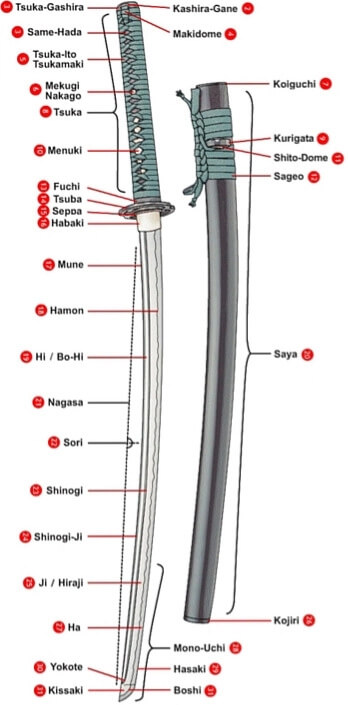
Technical Terminology of Katana Components
Tsuka – 27.5 cm Handle
The tsuka handle measures 275 mm and is covered with genuine stingray skin, samegawa, complemented by black hineri-maki wrapping.
Habaki – Brass Blade Collar
The habaki is made from brass and measures 26 mm in length. It helps ensure stable seating of the blade in the scabbard.
Kashira Made from Natural Horn
On this model, only the kashira handle end fitting is made from natural horn. The material of the other scabbard fittings is not described as horn.
Genuine Samegawa Stingray Skin and Hineri-maki
Samegawa (鮫皮) is a traditional material used on the handles of Japanese swords. The NOBUNAGA katana features genuine natural stingray skin with its characteristic firm, bead-like texture. The light-coloured samegawa contrasts with the black handle wrapping. Hineri-maki is a traditional method of wrapping tsuka-ito in which the cord is twisted at the crossing points. This creates regular diamond-shaped openings.
Menuki – Five-Petal Flower in the Style of Ume
Decorative silver-coloured metal menuki (目貫) are positioned between the openings in the black wrapping. Their decoration consists of a five-petal floral motif whose rounded petals visually correspond to the traditional Japanese plum blossom motif Ume (梅). The ume motif has a long tradition in Japanese culture and is associated primarily with perseverance and the ability to overcome difficult conditions, as the plum tree blossoms very early at the transition between winter and spring.
Glossy Black Saya with Gold Emblems
The NOBUNAGA katana is complemented by an elegant glossy black saya (鞘) made from hardwood. The smooth lacquered surface creates a striking contrast with the matte black handle wrapping and green sageo. The lower part of the scabbard is decorated with three gold decorative emblems of different sizes. These are not documented emblems of the Oda clan. The motif shown in the photograph consists of a stylised five-petal flower with a dragonfly.
Tombo / Kachimushi – the Dragonfly as a Traditional Warrior Motif
The Japanese word for dragonfly is tombo (蜻蛉). In traditional samurai symbolism, the term kachimushi (勝虫), literally “victorious insect”, is also used. The dragonfly motif was used on Japanese armour and sword fittings. Traditionally, it was associated with determination, forward movement and warrior resolve. On the NOBUNAGA model, the dragonfly is shown within a stylised five-petal flower. The gold design against the deep black lacquer creates one of the most distinctive visual details of the entire katana.
Green Sageo
The black saya is complemented by a distinctive green sageo (下緒) cord. It is tied in a decoratively traditional-inspired knot in the kurigata area. The green shade intentionally contrasts with the black scabbard and handle and visually distinguishes the NOBUNAGA model from the TADAKATSU katana.
Technical Specifications – NOBUNAGA ST-173
| Technical Specifications | |
|---|---|
| Name | NOBUNAGA (信長) |
| Model | ST-173 |
| Type | Collector's replica of a Japanese katana |
| Blade Material | S7 Shock Steel – tool steel |
| Blade Hardness | 55 HRC |
| Blade Geometry | Shōbu-zukuri (菖蒲造), without yokote |
| Blade Profile | Very flat, low niku |
| Blade Polishing | Hand Mirror Polishing |
| Blade Length Nagasa | 695 mm – measured from the end of the habaki |
| Overall Length without Saya | 990 mm |
| Tsuka Handle Length | 275 mm |
| Blade Thickness at Habaki | 8.0 mm |
| Curvature Sori | 20 mm |
| Weight without Saya | 980 g |
| Habaki | Brass, length 26 mm |
| Tsuba | Black steel Mokkō-gata, Sukashi, Sayagata pattern |
| Tsuka-ito | Black Hineri-maki wrapping |
| Samegawa | Genuine natural stingray skin |
| Menuki | Silver-coloured five-petal floral motif in the style of Ume (梅) |
| Kashira | Natural horn |
| Saya | Hardwood, glossy black lacquer |
| Saya Decoration | 3 gold emblems – Tombo / Kachimushi dragonfly in a five-petal flower |
| Sageo | Green decorative cord |
Traditional Japanese Cutting Tests on Mats
Traditional Japanese sword culture also includes tameshigiri (試し斬り), the practice of test cutting. In modern practice, specially prepared mats are often used for this discipline. Tameshigiri involves assessing the accuracy of technique and blade control. It is a specialised discipline requiring suitable equipment, experience and a safe environment. For practical cutting tests on mats, use only katanas whose construction has been expressly approved by the manufacturer for this purpose. S7 Shock Steel, a hardness of 55 HRC and Shōbu-zukuri geometry alone do not automatically guarantee such suitability.
Safe Handling
A katana requires responsible handling. It is not intended for contact sword fighting, duels or cutting hard objects. Practical cutting tests may only be performed with a suitable sword whose construction and intended use have been confirmed by the manufacturer, in a controlled environment under expert supervision. Always store the katana out of reach of children and unauthorised persons.
Katana Maintenance and Blade Protection
S7 Shock Steel is not corrosion-resistant stainless steel. To preserve the appearance of the blade over time, it should therefore be regularly maintained and protected from moisture.
Blade Care
After handling, remove fingerprints and moisture with a soft cloth. Apply a thin layer of suitable protective oil to the surface.
Protecting the Polish
Do not use abrasive cleaning products. The mirror-polished blade is sensitive to minor scratches and mechanical marks.
Proper Storage
Keep the katana in a dry, secure location. Avoid damp environments and significant temperature changes.
Frequently Asked Questions (FAQ)
What steel is the NOBUNAGA katana made from?
The blade is made from S7 Shock Steel tool steel with a hardness of 55 HRC.
What does Shōbu-zukuri mean?
Shōbu-zukuri is a traditional Japanese blade geometry in which the shinogi ridge continues smoothly to the tip without a separate yokote line.
What does Low Niku mean?
Low niku refers to very little convexity of the blade surfaces. NOBUNAGA has a very flat profile with minimal convexity.
Is the blade polished by hand?
Yes. The blade is hand-finished to a mirror shine using Mirror Polishing.
What are the dimensions of the NOBUNAGA katana?
The overall length without the scabbard is 99 cm, the Nagasa is 69.5 cm and the handle length is 27.5 cm. Blade thickness at the habaki is 8 mm, sori is 20 mm and the weight without the saya is 980 g.
What type of tsuba does the katana use?
The katana has a black steel four-lobed mokkō-gata tsuba with openwork sukashi decoration and a traditional geometric sayagata pattern.
What is the Sayagata pattern?
Sayagata is a traditional Japanese repeating geometric ornament formed by interconnected right-angled lines. The motif was historically also used to decorate tsuba and other decorative objects.
What motif do the Menuki have?
The menuki have a silver-coloured finish and a five-petal floral motif in the style of the Japanese Ume plum blossom.
What do the gold symbols on the Saya mean?
They are not documented emblems of the Oda clan. They are decorative emblems featuring a Tombo or Kachimushi dragonfly within a stylised five-petal flower.
What does Kachimushi mean?
Kachimushi is a traditional term for the dragonfly as a “victorious insect”. The dragonfly motif was used in Japanese warrior culture on armour and sword fittings.
Which part of the katana is made from horn?
On this model, the kashira, the end fitting of the handle, is made from natural horn.
What are the Saya and Sageo like?
The saya is made from hardwood with glossy black lacquer and three gold emblems. It is complemented by a green decorative sageo cord.
What is Tameshigiri?
Tameshigiri is a traditional Japanese cutting test in which specially prepared mats are also used in modern practice. The suitability of a specific katana for such use must be confirmed by the manufacturer.
Need Help Choosing a Katana?
We will be happy to help you choose a suitable model and explain its technical specifications. Contact the specialists at Nozeakatany.cz on +420 601 390 216 (Mon–Fri, 7:30 AM–4:00 PM).
NOBUNAGA ST-173 – Black and Green in Traditional Japanese Aesthetics
The NOBUNAGA ST-173 katana combines an S7 Shock Steel blade hardened to 55 HRC, Shōbu-zukuri geometry, a very flat low-niku profile and hand Mirror Polishing. It is visually distinguished from the TADAKATSU model by its mokkō-gata tsuba with sayagata ornament, silver-coloured floral menuki, green sageo and glossy black saya with three gold Tombo / Kachimushi emblems. The handle is complemented by genuine samegawa stingray skin and a kashira made from natural horn.
Additional parameters
| Category: | Katanas, Japanese swords and knives |
|---|---|
| Warranty: | lifetime |
| Weight: | 0.98 kg |
| EAN: | 8595705413436 |
| steel - blade material: | S-7 Shock Steel |
| blade length (nagasa) from the end of the habaki: | 2.30 Shaku - 69.5 cm |
| hamon (partial hardening): | Yes |
| Bo-Hi gutter: | no |
| suitable for cut-off tests: | Yes |
The Japan Swords brand represents a unique bridge between Japanese aesthetics and the millennia-old tradition of sword-making. These replicas are crafted in the legendary city of Longquan, which has been recognized for over 2,500 years as a center of exceptional blade production. Japan Swords revives the samurai legacy through handcrafted custom production, where each piece embodies discipline, honor, and master craftsmanship. The result is a collection of blades that serve both as historical symbols and as examples of refined metalworking.
#ShowMore#
The legacy of Longquan and the spirit of the samurai
The combination of Japanese philosophy and the Chinese sword-making heritage of Longquan results in products with outstanding mechanical properties. Local masters follow historical techniques enhanced with modern precision to achieve the ideal balance between flexibility and durability:
- Handcrafted production: Each piece from Japan Swords is individually made. This is not mass production, but precise work by experienced craftsmen.
- Authentic materials: Traditional hardening and steel folding techniques are used to ensure the characteristic appearance and structural integrity of each blade.
- Cultural significance: These products are not only functional replicas but also collectible items that carry deep cultural meaning and the philosophy of bushido.
Complete Japan Swords collection
Our selection includes carefully chosen pieces that meet the highest aesthetic and technical standards. The range features iconic Japanese blade types:
- Katana: The legendary long sword replica symbolizing samurai honor and craftsmanship at its peak.
- Wakizashi: A shorter companion blade, historically an essential part of a samurai’s equipment.
- Tanto: A precisely crafted dagger known for its simplicity and effectiveness.
For collectors and history enthusiasts
Japan Swords replicas are designed for lovers of Japanese culture, history, and traditional craftsmanship. They are ideal for private collections as well as for studying historical forms and techniques. Each blade reflects respect for materials and the centuries-old art of sword-making.
Owner’s note: Carbon steel blades require regular care to maintain their appearance and durability. We recommend cleaning and treating the blade with special oil to prevent oxidation and protect its unique structure.
Explore our Japan Swords collection and experience the fusion of history and craftsmanship. All products are carefully inspected to ensure the highest quality and to become a standout piece in your collection.