
Exclusive replica of the Diable Kuro katana – T-10 steel, Choji Hamon
Code: ST-121



Related products

Product detailed description
Exclusive functional katana Diable Kuro – T10, genuine Chōji hamon
Diable Kuro represents a higher class of functional replicas of traditional Japanese swords. It offers a sharp blade made of high-quality T10 carbon steel, genuine differential hardening, an edge hardness of approximately 58 HRC and a distinctive, naturally formed Chōji-type hamon.
The blade in traditional shinogi-zukuri geometry is made without a bo-hi groove and therefore retains a full, robust profile. The blade length including habaki is 735 mm / 73.5 cm, and the overall length of the katana without saya is 100 cm.
The higher level of craftsmanship is also evident in the koshirae. The katana features black-and-gold metal details, menuki with the motif of the Japanese Oni demon, black ito, a light samegawa base and a luxurious glossy black saya with golden glitter flakes. The stressed parts of the scabbard – koiguchi, kurigata and kojiri – are made of natural horn.
Diable Kuro is intended for more demanding collectors and enthusiasts of Japanese swords who are looking for a combination of a functional blade, genuine hamon and exceptionally refined details.
#ShowMore#
Premium T10 carbon steel blade
At the heart of the Diable Kuro katana is a sharp functional blade made of high-quality T10 carbon steel. This high-carbon steel is used for quality functional Japanese blades thanks to its ability to reach high hardness, retain an edge very well and respond suitably to differential heat treatment.
The edge of this model reaches a hardness of approximately 58 HRC. Combined with the full blade profile without bo-hi and traditional shinogi-zukuri geometry, this creates a strong and distinctive blade that matches the character of a higher-class functional replica.
You can find more about steels used for Japanese swords in the article Katana blade – complete overview of steels, types and quality.
Differential hardening and genuine Hamon
The blade is differentially, or partially, hardened. The edge area gains higher hardness, while the spine and body of the blade retain greater toughness.
It is precisely this method of heat treatment that creates a genuine hamon. It is therefore not an artificially ground, printed or merely surface-created line, but a natural result of the different hardening of individual parts of the blade.
You can find more about genuine hamon in the article Hamon – partial hardening of the blade.
Genuine Chōji Hamon
A characteristic feature of Diable Kuro is the genuine Chōji (丁子) hamon. Its rich and irregularly undulating pattern resembles clove flowers or buds and creates a striking visual effect on the polished surface of the blade.
Chōji is one of the traditional and visually attractive hamon forms. On the Diable Kuro model, it is not merely a decorative motif – it is the result of genuine differential hardening of T10 steel.
Shinogi-zukuri – traditional blade geometry
The blade has traditional shinogi-zukuri geometry, one of the most typical constructions of Japanese katana. The pronounced longitudinal shinogi line separates the main blade surfaces and supports a suitable balance between strength and cutting geometry.
Towards the tip, the blade transitions into a traditionally shaped kissaki, separated by the yokote line. The blade is made without bo-hi, and therefore retains a fuller and more robust profile.
Tsuka – black Ito and light Samegawa
The tsuka handle is fitted with a firm black ito wrapping. The regularly arranged tsukamaki creates characteristic diamond-shaped hishi openings beneath which the light samegawa base provides contrast.
The combination of black wrapping and a light base creates a classic Japanese aesthetic while also providing a suitable background for the distinctive black-and-gold metal elements of the handle.
More about handle construction: Tsuka, Ito and Samegawa.
Oni – the demonic character of Diable Kuro
A striking part of the handle is the black-and-gold menuki with the motif of the Japanese Oni demon. The sculpted face with contrasting golden details stands out from the black tsuka wrapping and emphasises the dark character of the Diable Kuro model.
In Japanese mythology, Oni are demonic and supernatural beings associated with strength, danger and protection from evil.
You can find more about menuki here: Menuki – decorative and functional element of the katana.
Black-and-gold Tsuba and Habaki
The katana is complemented by a dark decorative tsuba with contrasting golden details. Its craftsmanship continues the dark black-and-gold aesthetic of the handle and visually connects the individual koshirae elements into a unified whole.
Between the tsuba and the blade is a golden habaki, which surrounds the blade at the transition to the handle and ensures the blade is correctly seated in the saya scabbard.
More about the tsuba: Tsuba – guard, hand protection and katana style.
Luxurious Saya – black gloss with golden flakes
One of the details that clearly distinguishes the Diable Kuro katana from simpler models is its sophisticated glossy black saya with golden glitter flakes.
The golden elements are finely dispersed across the black surface and stand out best as the angle of incident light changes. From a greater distance, the scabbard appears elegant and almost minimalist, but up close it reveals a considerably more sophisticated texture.
The result is a luxurious black-and-gold combination that perfectly matches the tsuba, menuki and other metal details of the katana.
Koiguchi, Kurigata and Kojiri made of natural horn
The higher level of craftsmanship of the Diable Kuro model is underlined by the use of natural horn on three important parts of the scabbard – koiguchi, kurigata and kojiri.
Koiguchi reinforces the mouth of the saya where the habaki seats when the blade is inserted. This is a highly stressed part of the scabbard, so hard horn provides greater mechanical resistance here.
Kurigata serves as a firm attachment point for the sageo. Horn is suitable thanks to its strength, smooth surface and long service life.
Kojiri protects the lower end of the saya from mechanical damage. The horn end piece also looks elegant and traditional.
The use of horn on these stressed parts is one of the details that distinguishes more sophisticated koshirae from ordinary basic replicas.
Black Sageo
The saya is complemented by a strong black braided sageo, routed through the kurigata made of natural horn. The black colour matches the tsuka-ito and glossy saya while allowing the subtle golden details of the scabbard to stand out.
Anatomy of a Japanese katana – discover the individual parts
A Japanese katana is a sophisticated whole in which every component has its significance. In the image below you will find the basic terminology for the blade, handle and scabbard. Below the image, you can click individual terms to open a more detailed explanation in the Nože a Katany magazine.
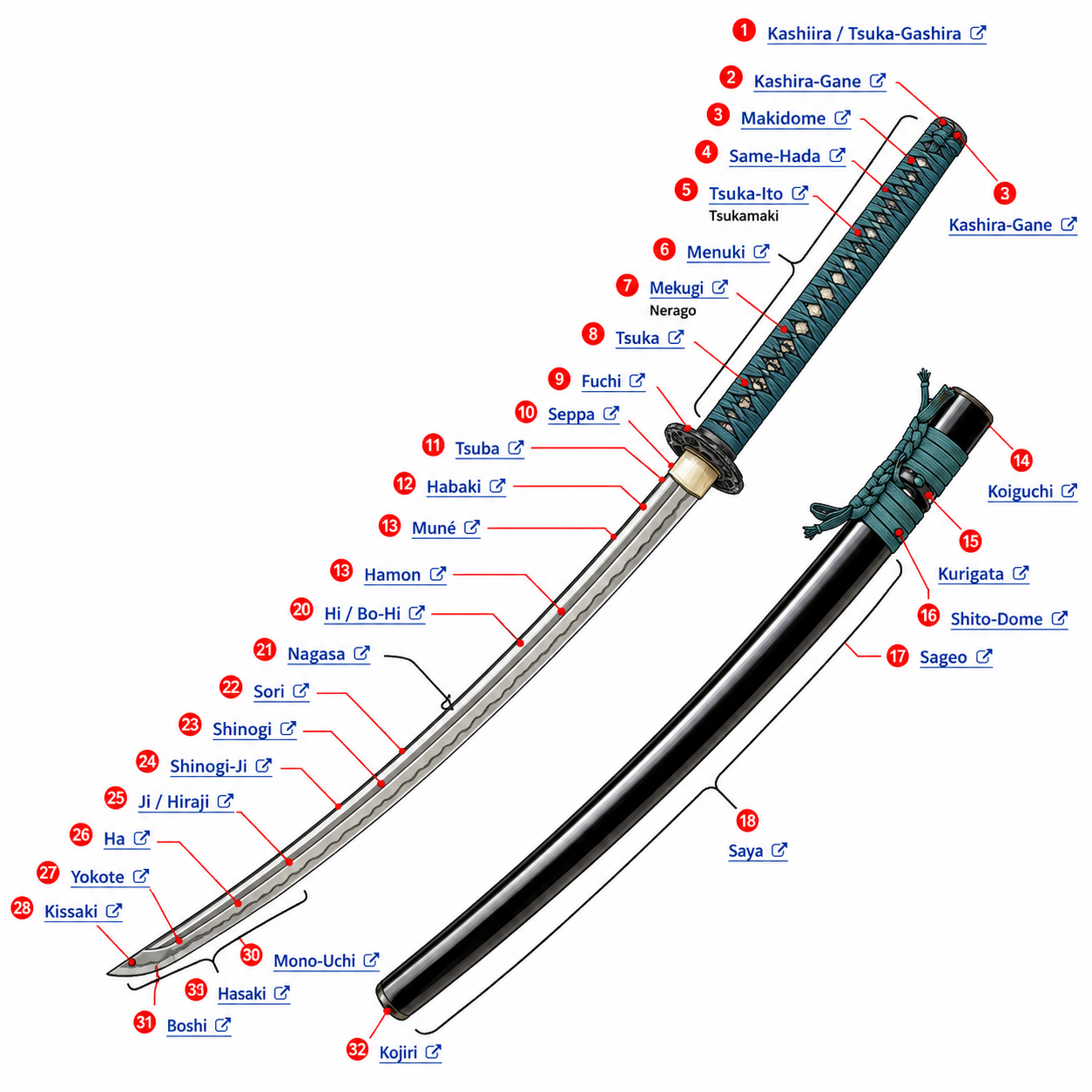
Click the highlighted names to open a more detailed article in a new window.
Katana handle – Tsuka
Tsuka – handle | Ito – wrapping | Samegawa – ray skin | Menuki | Mekugi | Fuchi | Kashira | Tsuba
Katana blade
Hamon | Shinogi | Shinogi-ji | Ji / Hira-ji | Mune | Ha | Yokote | Kissaki | Bo-hi | Nagasa | Sori
Saya – katana scabbard
Saya – scabbard | Koiguchi – mouth of the scabbard | Kurigata – sageo attachment | Shitodome | Sageo – cord | Kojiri – end of the scabbard
Diable Kuro technical specifications
| Brand | Japan Swords |
| Model | Diable Kuro |
| Product code | ST-121 |
| EAN | 8595705406148 |
| Type | Premium functional replica of a Japanese katana |
| Blade material | T10 carbon steel |
| Geometry | Shinogi-zukuri |
| Bo-hi | Without bo-hi |
| Hamon | Chōji – genuine hamon |
| Hardening | Differential / partial |
| Edge hardness | approx. 58 HRC |
| Blade length including habaki | 735 mm / 73.5 cm |
| Overall length without saya | 100 cm |
| Tsuka-ito | Black |
| Menuki | Oni motif, black-and-gold finish |
| Saya | Glossy black with golden glitter flakes |
| Koiguchi | Natural horn |
| Kurigata | Natural horn |
| Kojiri | Natural horn |
| Intended use | Premium functional replica / collector's Japanese sword |
Why choose the Diable Kuro katana?
Diable Kuro offers a combination of T10 carbon steel, differential hardening, genuine Chōji hamon, edge hardness of approximately 58 HRC and traditional shinogi-zukuri geometry.
The higher level of the model is also evident in the koshirae details: koiguchi, kurigata and kojiri made of natural horn, distinctive black-and-gold Oni menuki, decorative tsuba, black ito and a luxurious glossy black saya with golden flakes.
Diable Kuro is a katana for the more demanding collector who appreciates not only the quality of the blade itself, but also the refinement of all constructional and decorative details.
Maintenance of the T10 steel blade
T10 carbon steel requires regular care. After handling, we recommend cleaning the blade, removing fingerprints and then applying a very thin layer of suitable protective oil. Always store the katana with a clean and dry blade.
More about proper care: How to care for a katana – cleaning, oiling and maintenance.
FAQ – frequently asked questions
Is the Diable Kuro katana functional?
Yes. Diable Kuro ST-121 is a functional replica with a sharp T10 carbon steel blade.
Is the Chōji hamon genuine?
Yes. It is a genuine Chōji hamon created by differential hardening, not merely a decorative surface line.
What is the edge hardness?
The edge reaches a hardness of approximately 58 HRC.
How does Diable Kuro differ from basic katanas?
In addition to the T10 blade and genuine Chōji hamon, it offers more sophisticated koshirae, koiguchi, kurigata and kojiri made of natural horn, black-and-gold decoration and a luxurious black saya with golden glitter flakes.
What are the Koiguchi, Kurigata and Kojiri made of?
All three parts are made of natural horn.
What does the Saya look like?
The saya has a deep glossy black surface with finely dispersed golden glitter flakes.
What do the Menuki depict?
The menuki are designed in a black-and-gold style with the motif of a Japanese Oni demon.
Does the blade have Bo-hi?
No. The blade is made without bo-hi.
How long is the blade?
The blade length including habaki is 735 mm / 73.5 cm. The overall length of the katana without saya is 100 cm.
What are the product code and EAN?
The product code is ST-121 and the EAN is 8595705406148.
Additional parameters
| Category: | Katanas, Japanese swords and knives |
|---|---|
| Warranty: | lifetime |
| Weight: | 1.3 kg |
| EAN: | 8595705406148 |
| steel - blade material: | T-10 Hi-carbon steel |
| blade length (nagasa) from the end of the habaki: | 2.35 Shaku - 71.2cm |
| hamon (partial hardening): | Yes |
| Bo-Hi gutter: | no |
| suitable for cut-off tests: | Yes |
The Japan Swords brand represents a unique bridge between Japanese aesthetics and the millennia-old tradition of sword-making. These replicas are crafted in the legendary city of Longquan, which has been recognized for over 2,500 years as a center of exceptional blade production. Japan Swords revives the samurai legacy through handcrafted custom production, where each piece embodies discipline, honor, and master craftsmanship. The result is a collection of blades that serve both as historical symbols and as examples of refined metalworking.
#ShowMore#
The legacy of Longquan and the spirit of the samurai
The combination of Japanese philosophy and the Chinese sword-making heritage of Longquan results in products with outstanding mechanical properties. Local masters follow historical techniques enhanced with modern precision to achieve the ideal balance between flexibility and durability:
- Handcrafted production: Each piece from Japan Swords is individually made. This is not mass production, but precise work by experienced craftsmen.
- Authentic materials: Traditional hardening and steel folding techniques are used to ensure the characteristic appearance and structural integrity of each blade.
- Cultural significance: These products are not only functional replicas but also collectible items that carry deep cultural meaning and the philosophy of bushido.
Complete Japan Swords collection
Our selection includes carefully chosen pieces that meet the highest aesthetic and technical standards. The range features iconic Japanese blade types:
- Katana: The legendary long sword replica symbolizing samurai honor and craftsmanship at its peak.
- Wakizashi: A shorter companion blade, historically an essential part of a samurai’s equipment.
- Tanto: A precisely crafted dagger known for its simplicity and effectiveness.
For collectors and history enthusiasts
Japan Swords replicas are designed for lovers of Japanese culture, history, and traditional craftsmanship. They are ideal for private collections as well as for studying historical forms and techniques. Each blade reflects respect for materials and the centuries-old art of sword-making.
Owner’s note: Carbon steel blades require regular care to maintain their appearance and durability. We recommend cleaning and treating the blade with special oil to prevent oxidation and protect its unique structure.
Explore our Japan Swords collection and experience the fusion of history and craftsmanship. All products are carefully inspected to ensure the highest quality and to become a standout piece in your collection.